
The American founders knew what it meant to lose access to a jury. Among the grievances in the Declaration of Independence was the Crown’s role in “depriving us in many cases, of the benefits of Trial by Jury.” The Sixth Amendment then expressly guaranteed the accused an impartial jury drawn from the state and district where the crime occurred. The people who had objected to being tried without their neighbors wrote those neighbors into the new system of government.
Why put citizens between the government and the accused?
The Supreme Court explained the reason in Duncan v. Louisiana, 391 U.S. 145 (1968). Gary Duncan, a Black teenager, faced up to two years in prison over an encounter in which witnesses disagreed about whether he had slapped a white boy or touched his arm. Louisiana denied his request for a jury. A judge heard the witnesses, convicted Duncan and sentenced him to sixty days. In reversing, the Supreme Court held that the jury guarantee applies to serious criminal cases in state court. It identified two distinct dangers, the “corrupt or overzealous prosecutor” and the “compliant, biased, or eccentric judge.” Duncan did not have to prove that either official in his case fit that description. The choice to have jurors hear the witnesses was his to make.
The distinction matters even when everyone acts in good faith. A prosecutor who believes a witness can file a charge. A judge who believes the same witness can let the case go to the jury. But when a defendant exercises the right to a jury trial, even their combined certainty cannot establish guilt. Jurors hear the cross-examination, weigh competing accounts and decide whether the government proved its charge beyond a reasonable doubt. A judge cannot direct them to convict, however persuasive the evidence seems from the bench.
Who gets to speak for the community?
In 1955, an all-white, all-male Mississippi jury acquitted Roy Bryant and J. W. Milam of murdering fourteen-year-old Emmett Till. His great-uncle, Mose Wright, had stood in court and identified the men who took Till from his home. But black residents of the county had no voice in the jury room. The jury failed. When this happens, the public loses confidence in the criminal justice system.
To function properly, juries must fairly represent the communities they serve. When particular elements of the community are categorically excluded or routinely passed over, juries can reproduce the very hierarchy that citizens are supposed to hold in check.
That history gives practical meaning to the fair-cross-section requirement. In Taylor v. Louisiana, 419 U.S. 522 (1975), women could be called for jury service only if they first filed a written declaration volunteering to serve. Women made up 53 percent of those eligible in the district, yet there was not one woman in the pool of 175 people drawn for Taylor’s trial. The Supreme Court overturned his conviction. No defendant can demand a particular demographic mix among the jurors ultimately seated. But the state must draw the pool from a fair cross section of the community. Otherwise, officials can shape the judgment they are supposed to submit to simply by controlling who gets summoned.
When the summons comes
A jury summons can mean a lost shift, a scramble for child care or a day spent waiting in a courthouse only to be sent home. Those costs are real, and they fall hardest on the people with the least control over their time. But consider what we ask of someone accused of a crime. We ask that person to stand in a courtroom, listen as the government makes its case and trust strangers to give the defense a fair hearing. That promise depends on who can come through the courthouse doors and who, when able, is willing to come.
For most of us, jury service is one of the few occasions when a public official must sit down, present the evidence and wait for our answer. When the summons comes, that is a reason to serve.
What the jury’s verdict should mean on appeal and after conviction
The right to trial by jury must be enforced on appeal and in post-conviction proceedings. The review process undermines the essential function of juries to the extent that judges’ subjective opinions substitute for community sentiment.
One can think of the community sentiment expressed by jurors as an anchor. Its weight comes from the judgment of people drawn from the community who heard the witnesses, listened to the defense and deliberated under oath. The strength of evidence produced at a fair trial generates some probability that a jury will find the defendant guilty. In my writings, I refer to this probability as P(G | hypo), the probability of a guilty verdict in a hypothetical, error-free trial.
Suppose, at trial, the defense exposed weaknesses in an eyewitness’s identification. The jury considered the evidence and still credited the witness. If the trial was fair, then P(G | actual), the probability the jury would find the defendant guilty in his actual trial, is close to P(G | hypo). A reviewing judge’s own doubts about the witness’s credibility and the defendant’s guilt do not justify setting the verdict aside. Minor problems are tolerable. The defendant had a fair trial and lost. The outcome may have been surprising, but it was fair.
Now suppose the jury never learned that the eyewitness initially gave police a description that pointed away from the defendant. What exactly did those jurors decide about that discrepancy? Nothing. That is where respect for the jury cuts the other way. When there is a substantial trial error or omission, P(G | actual) is significantly larger than P(G | hypo). The jury could still believe there is enough evidence to convict, there is still some probability of conviction without the error, the defendant did receive the fair trial promised to him.
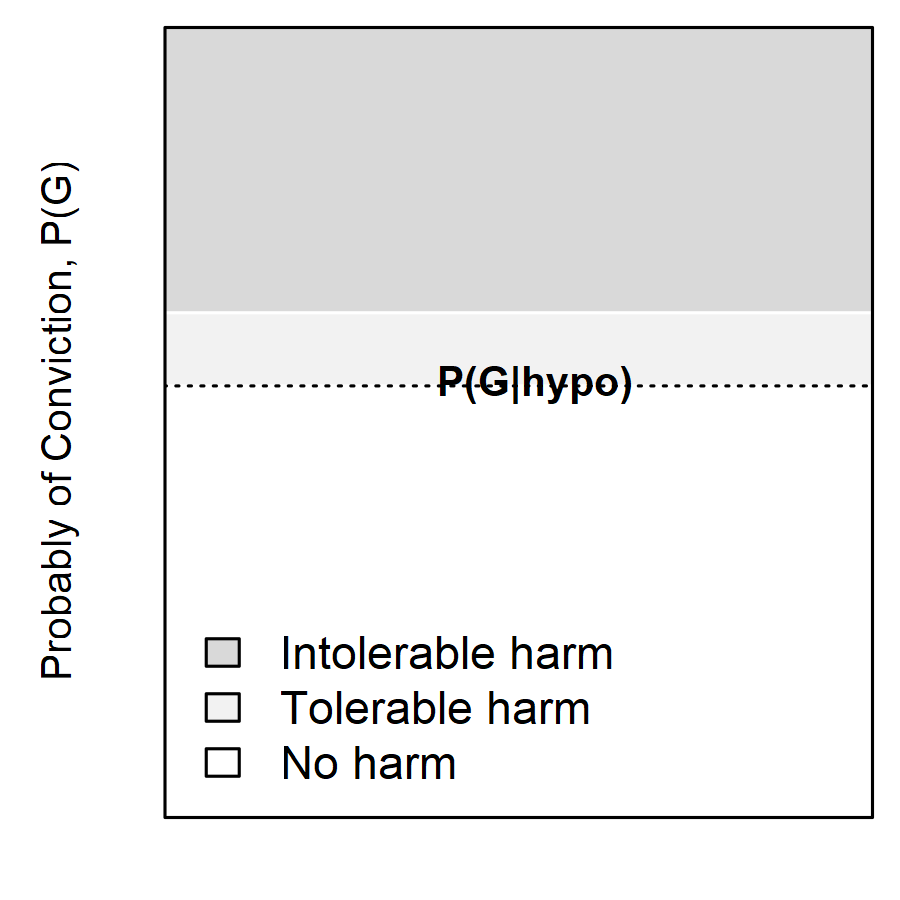
On appeal and in post-conviction proceedings, courts should respect what juries decide after fair consideration of the evidence. The problem is that the anchoring quantity, P(G | hypo), is not measured objectively or assessed in a rigorous fashion. Reviewing judges are not constrained by any measure of the defendant’s chances with the community. Reviewing judges are free to assert that a trial error or omissions caused no harm, tolerable harm, or intolerable harm. It is like reviewing whether an umpire correctly called a ball fair or foul when there are no lines on the field.