
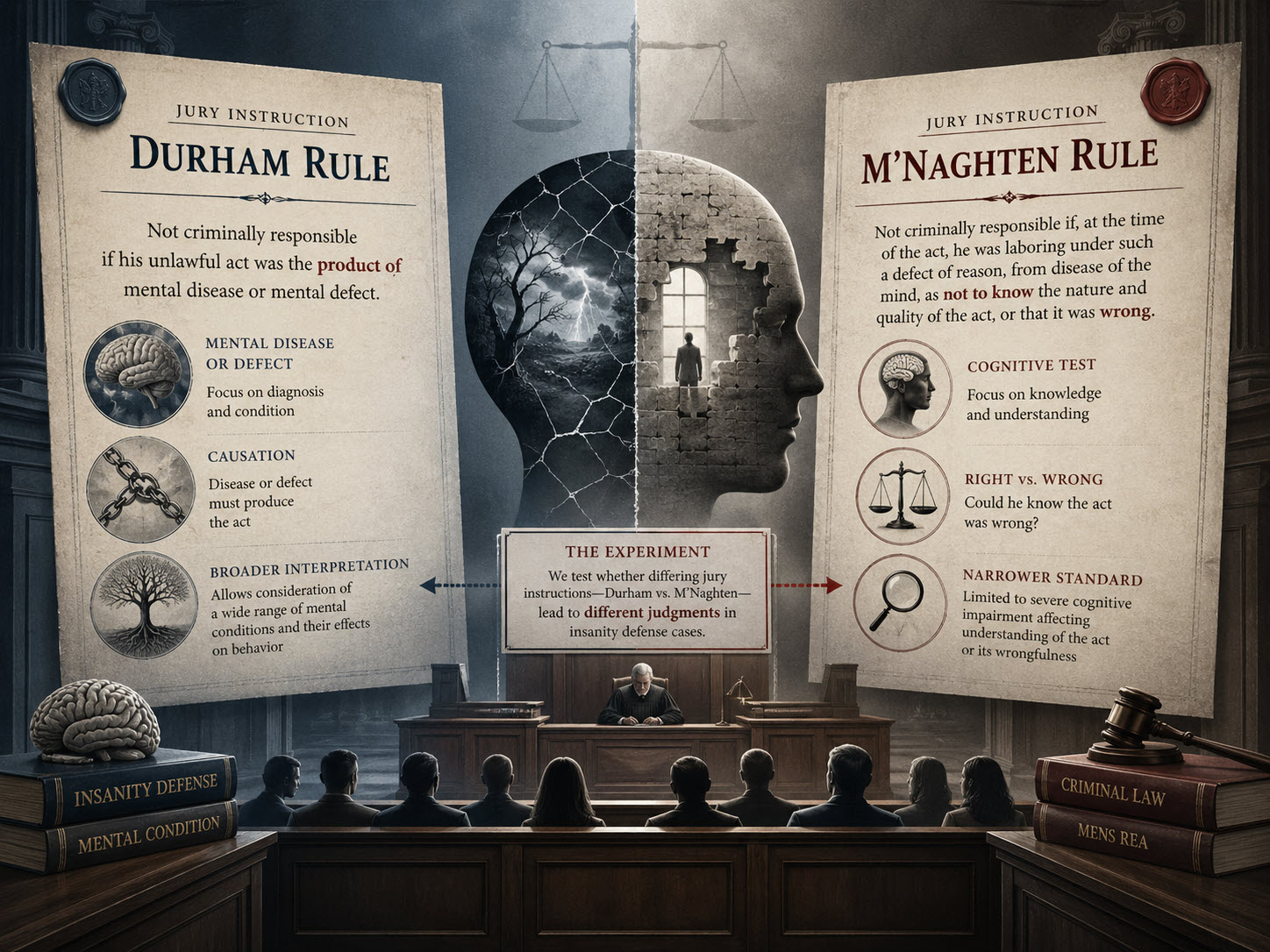
Jury instructions matter because they tell jurors what legal rule to apply. In most cases, the same evidence may look different depending on the legal standard the jury is asked to use.
United States v. King provides a useful example. The case involved an insanity defense, and Professor Rita James Simon later used the case as part of her landmark research on juries and the insanity defense. As part of the University of Chicago Law School’s American Jury Project, Simon randomly assigned real jurors summoned for jury service to consider the King case under different legal definitions of insanity.
The comparison focused on two major insanity standards: the M’Naghten rule and the Durham rule. Simon found that 76.0% of jurors given the M’Naghten instruction would find the defendant guilty, compared with 64.0% of jurors given the Durham instruction.
That is an important individual-level finding. My research in Measuring Fairness asks a further question: What does that shift in individual juror preferences imply for the probability that a jury would return a guilty verdict?
From Juror Preferences to Verdict Probabilities
Simon’s original provides experimental data from real jurors considering a real criminal case. Our contribution is to show how individual-level results like Simon’s can be translated into estimated jury-level outcomes.
That step matters because courts do not usually ask whether an error changed one juror’s mind in isolation. They ask whether an error, omission, or instruction created a reasonable probability of a different trial outcome. In jury trials, the relevant outcome is the verdict.
The method developed in Measuring Fairness uses jury-pool preferences and a deliberation model to estimate verdict probabilities. Simon’s King data show how many individual jurors favored conviction under each insanity instruction. The model then estimates how those individual preferences would likely translate into the probability that a jury would convict.
This makes it possible to evaluate the effect of jury instructions in a more concrete way. Instead of saying only that one instruction produced more guilty votes than another, the analysis estimates how much the instruction changed the probability of a guilty verdict.
Why This Case Study Matters
The King case study demonstrates that jury instructions can substantially affect trial outcomes. Legal rules do not merely guide jurors after they have already made up their minds. They can shape how jurors understand responsibility, mental illness, culpability, and guilt.
This is especially important when instructions concern complex legal concepts, such as insanity, consent, self-defense, reasonable doubt, or the elements of an offense. Small changes in legal framing can produce meaningful changes in how jurors classify the same conduct.
The larger point is that jury instructions are not just formal legal language. They are part of the causal structure of the trial. When instructions change how jurors apply the law, they may change the verdict itself.