
Jury Instructions
Jury-instruction errors arise when the court gives jurors inaccurate, incomplete, confusing, or misleading directions about the law they are supposed to apply. They can involve misdescribing the burden of proof, omitting an element of the offense, misstating a defense, or using language that materially alters how jurors understand a key legal concept.
The effect of jury instructions is an important issue for Fair Trial Analysis because jury instructions translate the law into decisions to be made by the jury. Flawed instructions are one of the recurring trial problems that can affect the probability of conviction and that can, in appropriate cases, be studied empirically rather than assessed only through intuition.
Some Jury Instruction Errors Are Harmful
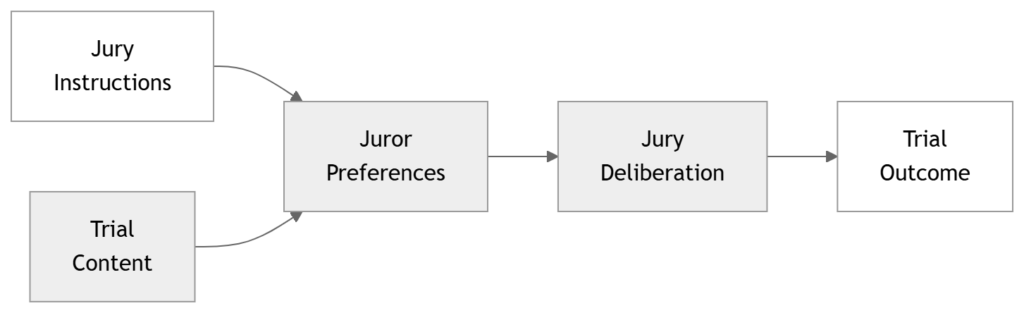
Jurors do not form verdict preferences based on trial content alone. They apply legal definitions and instructions to the trial content to make decisions. Wording matters. Holding trial content constant, more/less stringent jury instructions can affect whether jurors think the state has proven the defendant guilty. If jurors are told the wrong rule, or the right rule in misleading terms, jurors’ verdict preferences may be shaped in ways that affect both fairness and outcome.
Not every instructional mistake warrants reversal.
Some instruction errors are structural errors because they infect the entire verdict. Others are treated as ordinary trial errors and evaluated in context. The key distinction is between errors that undermine the basic framework of jury decision-making and errors that affect only part of the case.
The difference between structural errors, which require automatic reversal, and trial errors subject to harmless error analysis is not always clear or obvious, but it is important. See A Scientific Framework for Analyzing the Harmfulness of Trial Errors for detailed discussion of structural vs. ordinary trial errors and omissions.
Defective reasonable-doubt instructions are treated as structural errors, but most defective jury instructions affect only some aspects of a trial and are subject to harmless-error analysis. That means instruction claims are often case specific. The legal effect of an omitted or mistaken instruction depends on what kind of instruction it was, what issue it affected, how central that issue was to the case, and what the rest of the record showed.
Governing Supreme Court Framework
The Supreme Court’s cases establish a governing approach. Some jury-instruction defects are structural errors and require reversal without ordinary prejudice analysis. Most jury-instruction defects are treated as trial errors whose significance must be assessed in context.
At one end is Sullivan v. Louisiana (U.S. 1993), where the Court held that a defective reasonable-doubt instruction is structural error because a misdescription of the burden of proof “vitiates all the jury’s findings.” In that setting, there is no ordinary harmless-error inquiry because the defect reaches the foundation of the verdict itself.
At the other end are instruction mistakes that do not distort the basic structure of the trial in that way. Neder v. United States (U.S. 1999) is the leading example. There, the Court held that omission of an element from the jury instructions is a trial error subject to harmless-error review rather than automatic reversal. Greer v. United States (U.S. 2021) is another example of courts asking whether there is a reasonable probability of a different outcome from a mistaken instruction.
What Scientific Research Shows
The research literature strongly supports the view that instructions can affect verdicts. Instruction errors are not merely semantic. They can alter juror verdict preferences and, through deliberation, materially change outcome probabilities.
At the same time, every case is different. Some studies rely on students, convenience samples, or other non-representative samples. The field is stronger on guilt-phase outcomes than on sentencing outcomes. Much of the recent literature focuses on outcomes other than guilt and sentencing decisions, such as juror comprehension, satisfaction, and participation in deliberation.
Edwards’s own work extends that point into case-focused analysis. In Measuring Fairness, he examines two real-trial scenarios involving varying instructions. In the Berkowitz case study, instructing jurors that “no means no” rather than using the older common-law rape definition increased the estimated probability of conviction by .257. In the King case study, varying the definition of insanity produced an estimated .211 increase in the probability of conviction. Edwards notes that the lower bound of the estimated effect in Berkowitz was still .122, and in King the lowest plausible effect was .1002, both around or above the proposed threshold of intolerable harm.
The clearest and most durable pattern in existing research is that burden-of-proof wording can move conviction rates. The general story is not just that any definition matters; rather, some formulations appear to sharpen calibration while others make conviction easier by blurring the jury’s task. As noted above, defective reasonable doubt instructions are currently treated as structural errors which require automatic reversal without regard to their actual harmfulness.
A second pattern is that instruction effects are highly contextual. Nullification instructions do not simply lower convictions; they increase acquittals for sympathetic defendants and can increase convictions when the defendant seems dangerous or morally blameworthy. This is important because it supports talking about instructions in probabilistic, case-specific terms rather than as universally “pro-defense” or “pro-prosecution.”
A third pattern, and one especially relevant to empirical analysis, is that the literature contains evidence of both harmful and harmless instructional variation. Some instruction variants that seem legally important may not materially alter verdicts. The literature is not just a catalog of harmful instruction errors; it is also a set of benchmarks for distinguishing harmful and harmless jury instruction errors.
Jury Instruction Studies with Random Assignment
|
Study |
Instruction Studied |
Additional Notes |
Reported Effect(s) |
|---|---|---|---|
|
Edwards (2026) reanalysis of Simon |
Insanity defense |
Real jurors, live re-enactment of trial |
Jurors less likely to find defendant guilty under Durham instruction than M’Naughton instruction |
|
Edwards (2026) reanalysis of Kahan |
Definition of rape |
Nationally representative sample |
Conviction rates depend on definition of consent |
|
Peter-Hagene & Ratliff (2021) |
Nullification |
Euthanasia scenario |
Nullification instructions amplified the effect of euthanasia attitudes on verdicts. |
|
Cicchini & White (2017) |
Reasonable doubt |
248 mock jurors (124 per group) |
Conviction rates were 22.6% under the proper doubt-only instruction and 33.1% under the doubt-plus-truth instruction |
|
Cicchini & White (2016) |
Reasonable doubt, burden of proof |
298 mock jurors; child-sexual-assault fact pattern. |
Conviction rates were 29.6% under truth-only, 16% under doubt-only, and 29% under the combined doubt-plus-truth instruction |
|
Wright & Hall (2007) |
Reasonable doubt |
Undergraduate participants; written case summary |
In Experiment 1, guilty verdicts were 38% in control versus 54% with the added instruction |
|
Koch & Devine (1999) |
Reasonable doubt crossed with availability of a lesser charge |
Mock juries of 4–7 persons; based on a real murder-trial transcript. |
A lesser charge produced more overall convictions when reasonable doubt was left undefined; by contrast, more convictions occurred when reasonable doubt was defined using “firmly convinced” language |
|
Horowitz & Kirkpatrick (1996) |
Supplementary reasonable doubt definitions |
80 six-person juries |
The “firmly convinced” instruction elicited the highest proof thresholds and verdicts that best tracked the evidence; in weak cases it yielded fewer convictions, but differences disappeared in strong cases |
|
Ogloff (1991) |
Insanity defense together with burden-of-proof variations |
403 undergraduate mock jurors |
Accessible summaries indicate no significant verdict differences across the insanity-standard conditions, and no significant verdict effect from shifting burden or standard of proof |
|
Borgida & Park (1988) |
Subjective versus objective entrapment instructions |
Student-juror sample; videotaped cocaine trial with prior conviction |
Prior-conviction evidence had a significant impact on verdicts in the subjective-instruction condition, but not in the objective-instruction condition |
|
Horowitz (1988) |
Source of nullification information |
144 six-person juries |
When juries received nullification information from the judge or defense attorney, they were more likely to acquit sympathetic defendants and to judge dangerous defendants more harshly than when the information was absent or challenged |
|
Horowitz (1985) |
Nullification |
45 six-person juries (270 participants) |
Explicit nullification instructions led juries to be less likely to convict in a euthanasia case, more likely to convict in a drunk-driving case, and showed no meaningful difference in a murder case |
|
Kassin & Wrightsman (1979) |
Timing of burden-of-proof instruction |
107 mock jurors; one-hour videotaped criminal trial. |
Guilty verdicts were 37% when instructions came before the evidence, versus 59% when given after and 63% with no instruction |
|
Kerr et al. (1976) |
Definition of reasonable doubt |
606 student mock jurors, rape trial simulation |
Lax wording produced a higher conviction rate, stringent wording a lower conviction rate, and undefined instructions fell between them. |
|
Sealy & Cornish (1973) |
Burden of proof |
Representative community sample, tape recorded trials |
Postdeliberation guilt preferences varied by 4–23 percentage points across conditions |
Why This Issue Matters
Jury instructions are where the court tells jurors what the law means. If that translation fails, the verdict may rest on the wrong legal standard even if the jurors acted conscientiously.
For Fair Trial Analysis, this is a central issue because jury-instruction problems are both legally significant and empirically tractable. Some are structural and require reversal as a matter of constitutional design. Others are trial errors whose likely effects can be studied scientifically. In either setting, the issue goes to a basic fairness question: whether the jury decided the case under the law it was actually supposed to apply.